
This is the second of two articles signifying the successful conclusion of our Sukuta Project. The first immediately precedes it, on this blog
We have feautured the project frequently over the last three years in words and pictures. This episode is aimed at showing, mainly in picture form, the difference your - and Rotary's - money has made to the 2,000 children attending the school.
 | |
| On International Women's Day 2022, the then head of Sukuta LBS (Mariam Mendy, dressed in white, second from left), the CEO of contractors Future In Our Hands (Jainaba Sarr, dressed in orange, second from right), together with then President of Brusubi Rotary club (Omar Jallow, far left) and John Walker, representing Sohm Schools Support and Redbridge Rotary (far right) sign contract for FIOH to deliver the Sukuta project. | |
There were seven aspects to the project. Below, adopting a before and after approach, we present a photographic essay of the differene our Sukuta project has made to a large number of young African lives, now and for many years into the future.
Water Supply
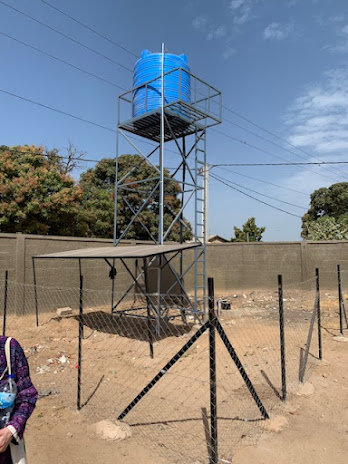 |
| Before: one water tank for 2,000 pupils |
 |
| After (1): second water tank ready for installation |
 |
| After (2): second water tank in place |
Doubling the water capacity of the water supply enables much more hygenic practice and cleanliness around the school.
Standpipes
.JPG) |
| Before: There was only one water standpipe for 2,000 children to wash their hands (including after toilet and before food) in the entire school. |
.JPG) |
| After (1): one of the ten new standpipes installed in the school |
.JPG) | |
|
%20Alpha%20Omar,%20President%20of%20Brusubi%20Rotary%20club,%20with%20pupils%20using%20one%20of%20the%20new%20standpipes.JPG) | |
|
Toilets
Before (1 and 2): Old toilets, before the project


.jpg)
Under construction: The new toilets
.JPG)
.JPG) |
| After (1 and 2): running water in new hygenic toilets, for the first time |
Library
.JPG) |
| Before (above and below): Old library suffering from termite damage and unusable |

.jpg) |
| After (above and below): newly reconstructed library, termite free and fit for use. The building is waiting for Brusubi Rotary Club to provide the promised furniture, and then it will be up and running and a fabulous facility for 2,000 pupils |
.jpg)
Sick room
 |
| Before: No sick room in the school; a space identified to construct one |
.JPG) | |
|
Computer room
 |
| Before: too small, unfit for purpose and unable to offer space for all the pupils |
 |
| After (above and below): greatly expanded facility, with air-con, in which all pupils can receive ICT lessons |

Vendors stalls
 |
| Before: The hot, unhygenic place where local women sold school lunches to the 2,000 pupils at the school |
.jpg) |
| After (1 and2)- above and below: the new clean, hygenic building created for local traders to sell lunches to the school's children |
.jpg)
 |
| After (3 and4)- above and below: traders setting up, and children using the new school meals facility |

Signed, sealed, but not fully delivered - yet
A year ago Redbridge Rotary (with significant SSS backing) and Rotary International provided the money for the completion of the Sukuta project. Under the terms of the agreement, Brusubi Rotary club were entrusted to supervise its delivery. Contractor, Future In Our Hands, went beyond expectations in executing the contract to price, despite building supply price inflation.
The completion of the project was hailed on Gambian TV and Brusubi Rotary club, via current president, Alpha Jallow, was happy to take credit for the delivery of this carefully constructed and delicately financed project.
It has been a great success, and SSS supporters and Rotarians, world-wide are to be thanked and praised for their generosity in ensuring that.
All that is needed now is for Brusubi Rotary club to put its money where its mouth is (to the tune of less than $1,000 US) and deliver on the promises it made to Gambian TV and furnish the library and sick room. That simple, low cost, pain-free gesture will ensure that 2,000 young Gambians will benefit from everyone else's efforts.
It will also illustrate that Rotary values are extended to and be displayed by Gambian Rotarians too. Service before self-service. Charity before vanity.
,%20Jainaba%20Sarr%20(centere%20-%20Future%20in%20Our%20hands,%20with%20school%20leaders%20and%20governors.JPG) |
| The four photos, above and below, are of Brusubi Rotary President, Alpha Jallow taking credit for the delivery of the project. Now let the club deliver on its promises. |


